Machine learning projects are becoming increasingly complex, requiring powerful CPUs, large memory capacity, fast storage, and often GPU acceleration.
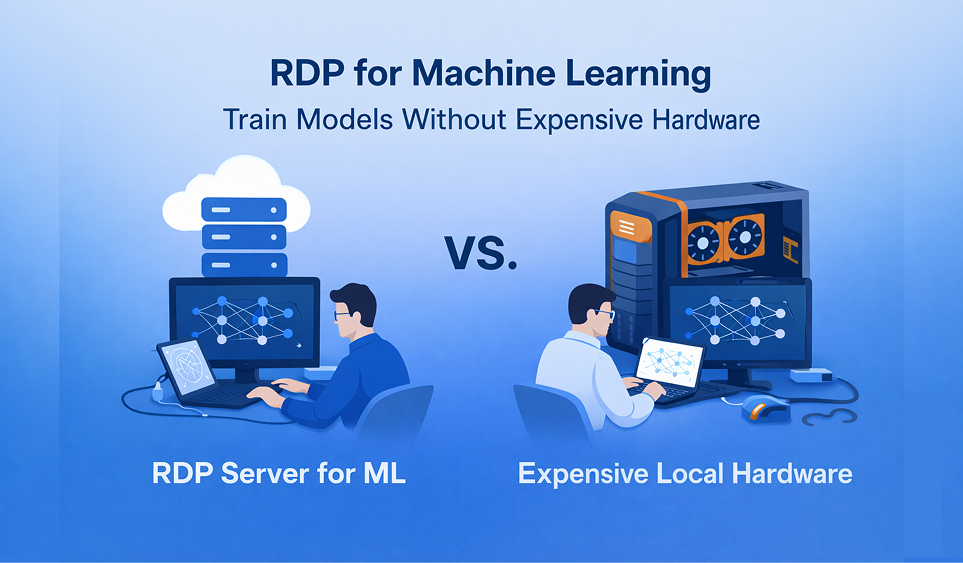
Machine learning projects are becoming increasingly complex, requiring powerful CPUs, large memory capacity, fast storage, and often GPU acceleration. For many developers, data scientists, startups, and businesses, investing in expensive local hardware is not practical or scalable.
This is where RDP for machine learning offers a powerful alternative. By using Remote Desktop Protocol (RDP) servers, teams can build a cloud-based machine learning environment that enables remote model training, experimentation, and deployment—without the need for high-end local machines.
In this article, we explore how RDP VPS for machine learning works, its technical and business advantages, and why PCRDP RDP solutions are ideal for training machine learning models remotely.
Training machine learning and deep learning models requires significant computing resources. Common limitations of local setups include:
Most personal computers struggle with CPU-intensive and memory-heavy ML workloads, leading to long training times and inefficient experimentation.
Dedicated GPUs suitable for AI and deep learning are expensive and require ongoing maintenance, power, and cooling.
Local hardware does not scale easily when datasets grow or multiple experiments run in parallel.
Training jobs may stop due to system crashes, shutdowns, or performance throttling.
Using a remote desktop for machine learning shifts these challenges to a reliable cloud infrastructure.
Remote Desktop Protocol (RDP) allows users to connect to a remote machine learning server and control it as if it were a local desktop. All ML workloads—training, testing, and inference—run directly on the remote server.
This makes RDP an ideal solution for remote AI development.
An RDP ML server provides access to enterprise-grade CPUs, high RAM, fast SSD storage, and optional GPU support—eliminating the need to purchase costly hardware.
Using RDP VPS hosting for machine learning allows teams to pay only for the resources they need. This is ideal for startups, freelancers, and research teams working with limited budgets.
As workloads grow, RDP servers can be upgraded easily. This scalability supports large dataset processing, deep learning models, and parallel experiments.
All source code, datasets, and trained models remain on the remote server, improving data security and compliance.
Even low-end laptops can be used for advanced ML development since all processing happens on the RDP server.
RDP-based environments support a wide range of AI and data science applications, including:
Select an RDP server for machine learning training with:
PCRDP RDP servers are designed to handle CPU-intensive and AI workloads efficiently.
Set up essential ML tools such as:
This creates a remote data science environment optimized for productivity.
Upload datasets directly to the RDP server or integrate cloud storage solutions to ensure fast access and secure handling.
Run training jobs directly on the RDP server. Even if your local system disconnects, the training process continues uninterrupted.
Monitor CPU, memory, disk, and GPU usage to optimize performance and scale resources as needed.
RDP-based ML environments are ideal for:
PCRDP offers professional RDP VPS hosting tailored for machine learning and data science workloads. Benefits include:
With PCRDP RDP solutions, you can focus on building models—not managing infrastructure.
Machine learning no longer requires expensive local hardware. By using RDP for machine learning, developers and data scientists can train models remotely on secure, scalable, and high-performance servers.
If you’re looking for a reliable way to build and train machine learning models without hardware limitations, PCRDP’s cloud RDP servers provide the perfect foundation.